

Montana Native American Maternal Health
Community Advisory Board
The Montana Native American Maternal Health Community Advisory Board (CAB) is an Indigenous-led effort established in early 2024, grounded in community voice, lived experience, and collective care. The CAB brings together diverse members, including Indigenous mothers, fathers, birthworkers, doulas, and nurses, to guide and strengthen maternal health outcomes in Tribal communities. Stewarded by Berry Medicine Native BirthWork Initiatives, the CAB centers culturally grounded approaches and acts as a trusted space for Indigenous leadership, ensuring that maternal health efforts are responsive and aligned with the needs of Tribal and Urban Native communities.
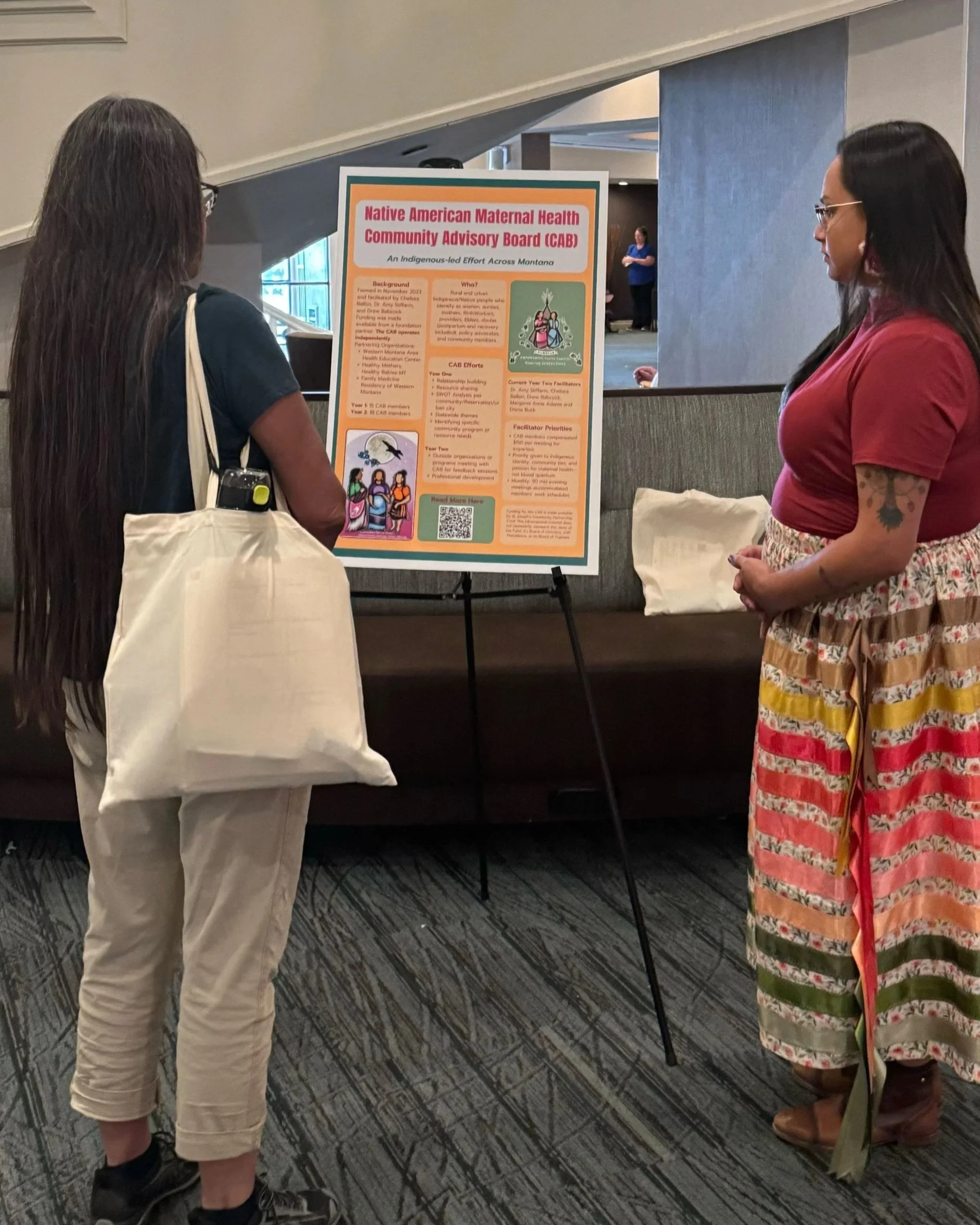
The Native American Maternal Health Community Advisory Board (CAB) is an Indigenous-led effort grounded in community voice, lived experience, and collective care. The CAB brings together individuals with diverse backgrounds and perspectives including Indigenous mothers, aunties, birthworkers, doulas, nurses, and fathers to guide, inform, and strengthen program efforts.
In 2023, an intentional partnership was formed between the Native American Initiatives program at Healthy Mothers, Healthy Babies - The Montana Coalition, the Western Montana Area Health Education Center, and the Family Medicine Residency of Western Montana.The shared goal of this collaboration is to strengthen maternal health outcomes in Tribal communities through relationship-building, collaboration, and culturally informed education.
Established in early 2024, the CAB has grown into a trusted and respected space for Indigenous leadership & guidance. Now in its third year, the CAB continues to evolve under Berry Medicine Native BirthWork Initiatives, centering community-led and culturally grounded approaches to maternal health.
Meet Our Board
Alyssa Schock
Confederated Salish and Kootenai Tribes (CSKT)
Alyssa is a member of the CSKT and a Doctor of Physical Therapy specializing in pelvic health across the lifespan. She has extensive experience developing hospital-based prenatal care programs and providing specialized postpartum rehabilitation. Alyssa is also the founder of The Every Woman Project, an innovative digital platform designed to bridge gaps in care by delivering accessible, culturally informed pelvic health education to women everywhere
Kaycee Martinez
Northern Cheyenne Nation
Kaycee is a mother of four and the Family Spirit Director on the Northern Cheyenne reservation, a role she has held for five years. She serves as a vital resource beacon for her community, connecting young families to both on- and off-reservation resources, Cheyenne language teachings, and developmental programs. Kaycee is a passionate advocate dedicated to protecting, informing, and empowering families from the ground up.
Amber Birdinground
Crow Nation (Apsáalooke)
Amber is a member of the Greasy Mouth Clan and a child of the Big Lodge Clan within the Crow Nation. Raised with deep Apsáalooke values and traditions, she holds a Bachelor of Science in Nursing from Montana State University. Amber is fiercely dedicated to serving the Apsáalooke people in healthcare, acting as a patient advocate to bridge communication and cultural understanding, while also guiding the next generation of Indigenous public health professionals.
Charlene Ramirez
Blackfeet Nation
Charlene is a proud member of the Blackfeet Nation and an experienced labor and delivery nurse of 18 years. Based in Billings, MT, her passion for maternal health is rooted in providing accessible, culturally grounded childbirth and breastfeeding education to Indigenous women in both rural and urban areas. Charlene actively collaborates with Indigenous doulas to bring vital wraparound support and education directly to her community.
Danielle "Dani" Marie Vazquez
Chippewa Cree / Shoshone Bannock
Dani is a member of the Chippewa Cree and Shoshone Bannock tribes. As a community organizer, auntie, and full-spectrum doula, her work is deeply guided by a commitment to reproductive justice, tribal sovereignty, and community care. Dani is dedicated to ensuring that all birthing people have access to the care, resources, and support they deserve, recognizing that maternal health is intrinsically tied to broader social and economic justice.
Callie Parr
Little Shell Tribe of Chippewa Indians
Callie is a first-generation descendant of the Little Shell Tribe of Chippewa Indians. Drawing from her own lived experiences as a teen parent and her journey in recovery, she is a passionate advocate for creating compassionate, accessible systems for families. Armed with a degree in early childhood education, Callie partners with tribal communities and educators across Montana to ensure families are empowered, supported, and connected to their cultural strengths.
Julianne Denny
Membertou First Nation / Rocky Boy
Julianne is a Cree, Ojibway, and Miqmaq woman, as well as a dedicated mother of four. She serves her community as a Full-Spectrum Indigenous Birthworker, Peer Recovery Doula, and Indigenous Lactation Counselor in the Hill County and Chippewa-Cree Tribe areas. Holding degrees in Addictions Studies and Fine Arts, Julianne is a strong advocate for increasing authentic Indigenous representation in the medical field and preserving traditional arts.
Ni'Cole Triplett
Blackfeet Nation
Ni’Cole is a Blackfeet woman and Indigenous doula who brings lived experience and a deep commitment to Indigenous health equity to her work. She has built her career around strengthening culturally responsive programs, from statewide tribal health initiatives to developing Urban Indian Health Centers. Ni'Cole is passionate about integrating traditional knowledge with clinical care and expanding access to wraparound perinatal supports so that Indigenous families feel safe, seen, and respected.
Stevie Werk
Gros Ventre / Assiniboine
Stevie is of Gros Ventre and Assiniboine descent and a proud mother of five. She works at Life’s Language Lodge, an immersion daycare serving children ages 0-5. Inspired by her recent participation in doula training, Stevie is deeply committed to expanding support and resources for mothers and families within her area, bringing a community-first mindset to maternal and family health.
CAB Structure & Participation
The CAB meets regularly (monthly) for facilitated sessions focused on discussion, feedback, and collaboration
Meetings are held in the evenings to support accessibility for members with varying schedules
Members are compensated for their time, expertise, and contributions
Participation is grounded in community connection, lived experience, and a shared commitment to improving maternal health outcomes
Membership reflects a range of Indigenous identities and experiences, prioritizing connection to community and passion for maternal and family health
Community Engagement & Collaboration
The CAB also serves as a bridge between communities and organizations seeking meaningful engagement with Indigenous populations. Programs, partners, and statewide initiatives may engage with the CAB through structured feedback sessions, presentations, and collaborative discussions.
Through this role, the CAB helps ensure that maternal health efforts are responsive, respectful, and aligned with the needs and priorities of Tribal and Urban Native communities.
Join & Connect
Berry Medicine Native BirthWork Initiatives welcomes continued connection with Indigenous community members, birthworkers, and partners who are interested in engaging with the Native American Maternal Health Community Advisory Board.
To learn more about the CAB, request collaboration, or inquire about participation opportunities, please connect with us at info@berrymedicine.org