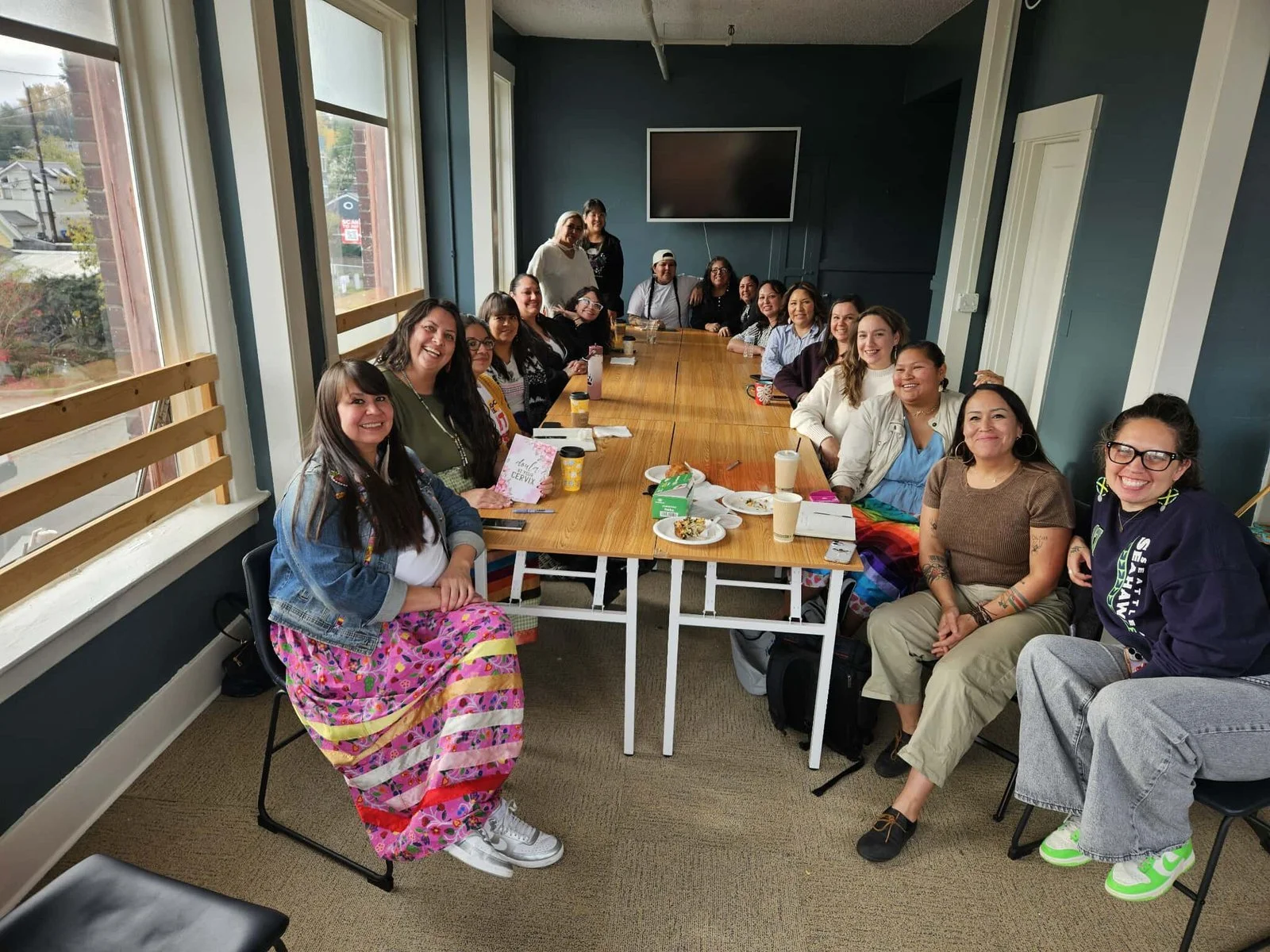
Indigenous BirthWorkers from Montana learning alongside Hummingbird Indigenous Family Services in Seattle one year ago.
Part Three of The Conversation We Should Be Having: A Berry Medicine series on Native maternal health, community strengths, and changing the systems surrounding Native Birthing Families.
Thanksgiving is a complicated time.
Like many people, I grew up with a version of the Thanksgiving story that left a lot out. The familiar story of Pilgrims and Indians sharing a meal has too often been used to soften or erase the violence, land dispossession, broken agreements, and harmful policies brought onto Indigenous People when this Land was colonized.
More people are questioning that story now, learning the histories that weren't taught to us, and having more honest conversations with their families. A shift that I am glad to see happening. At the same time, many of us use this time as an opportunity to slow down, spend time with the people we love, and express gratitude. That part has always resonated with me as an Indigenous person raised in a Tribal community.
Gratitude isn't something Native people learned from Thanksgiving. Our people have longstanding teachings and practices around gratitude, reciprocity, responsibility, and our relationships with the world around us. Robin Wall Kimmerer writes beautifully about this in Braiding Sweetgrass, where she includes the Haudenosaunee Thanksgiving Address and what it teaches us about our relationships with the living world.
So while Thanksgiving can be a complicated holiday for Indigenous people, at Berry Medicine we're choosing to use this week to lean into gratitude.
And lately, I've been feeling especially grateful for how we got here and the people who helped along the way.

Before there was Berry Medicine
Before Berry Medicine had a name, I was doing independent consulting around maternal and child health while working toward my PhD in Indigenous Health. At the time, I had a hard time finding and connecting with others doing Indigenous maternal health work in Montana. That doesn’t mean the work wasn’t happening. Our people have always been caring for our families, but there weren’t many formal opportunities for us to connect and collectively move this work forward.
I started following what Indigenous maternal health leaders were building in other parts of Indian Country, organizations like Hummingbird Indigenous Family Services in Washington, Alaska Native BirthWorkers Community, and the Indigenous Lactation Counselor Training. In spring 2022, Camie invited me to Minneapolis to gather with other people doing this work. They welcomed me, mentored me, and were generous with their experiences and what they’ve been learning. They didn’t treat knowledge as something they needed to protect from one another. That experience stayed with me. Learning about all of the work happening and developing relationships with the Native Women leading the way was foundational to my education and how I approached my work. It was so encouraging to see what was possible, but at the same time I couldn’t help but worry that Montana was behind.

I found my people.
I walked into a room full of brilliant Indigenous women who were caring for their communities, strengthening Indigenous birthwork, and working to change systems that weren’t serving our families well.
The work started growing
One of the organizations I was consulting with at the time was Healthy Mothers, Healthy Babies – The Montana Coalition (HMHB). After completing a project together, their Executive Director at the time, Brie MacLaurin, invited me to join the organization and develop work specifically focused on maternal health for Native families. That work became the Native American Initiatives program. As the work grew, it became clear that what we were developing needed a home of its own. If this work was going to be grounded in Native communities, Indigenous knowledge, and Indigenous leadership, it needed to become fully Indigenous-led.
In June 2024, Stephanie Morton and I brought people together to begin imagining what that could look like. At the end of that meeting, someone asked me what we would call it and I had absolutely no idea. I remember feeling overwhelmed by that question. How do you come up with a name for something you have so much hope for but don’t quite know what it’s going to look like yet? I decided not to force it and trusted that the name would come to me eventually. Later that year, it did.

Finding our name
In December 2024, I started reading Robin Wall Kimmerer’s book, The Serviceberry: Abundance and Reciprocity in the Natural World. I was immediately drawn to her reflections on the Serviceberry, or what we call Juneberries in Fort Belknap, and what the Juneberry bush can teach us about abundance, generosity, and reciprocity. It made me think about the organization we were building.

Not scarcity. Not another model built around everything Native communities supposedly lack. I wanted something rooted in what our communities already have: our knowledge, culture, relationships, Elders, birthworkers, families, and our responsibility to care for one another across generations. I wanted to create more opportunities for our families to benefit from that abundance. That was the medicine I wanted for our Native Birthing Families and communities. That’s when the organization we were building had its name.
Berry Medicine.
Dreaming it into existence
Less than a year later, Berry Medicine received seed funding from the Montana Women’s Foundation. That support gave us resources to work with consultants and an attorney to begin figuring out what it would take to establish an independent, Indigenous-led nonprofit. In April 2025, Berry Medicine registered as a Montana nonprofit. That August, we entered into a fiscal sponsorship agreement with Healthy Mothers, Healthy Babies of Montana.
Their board and staff supported the transition and wanted to see this work succeed. Even with those pieces in place, though, we were still figuring out when and how to move the work from Native American Initiatives to Berry Medicine. We wanted to be intentional about moving the work forward without disrupting the programs and relationships we had spent years building.
Then, about a year ago, we were able to organize a group of Indigenous doulas from Montana to travel to Seattle to learn directly from Hummingbird Indigenous Family Services. Right before the gathering, I shared with the group what we were working toward with Berry Medicine. During that trip, whenever we had some downtime, Adriann, Shawnalea, Diona, and I found ourselves strategizing about what Berry Medicine could become. We dreamed together about what we wanted for our communities, with inspiration and motivation at an all-time high after our Hummingbird visit. We strategized and shared ideas about how this work could move forward without losing the relationships, trust, and community that had made it possible in the first place.

I remember Adriann telling me:
“This is going to happen a lot sooner than you think. You need to be ready.”
I don’t think any of us imagined that one year later, all four of us would be working full time for the organization we were sitting there dreaming about.

On April 1, 2026, we officially launched as Berry Medicine Native BirthWork Initiatives.
And here we are.
None of this was built alone
When I look back now, what stands out most is how generous others have been with their knowledge. Camie and the team at Hummingbird opened their doors and shared what they had learned with us. Alaska Native BirthWorkers and Tribal maternal health leaders in Arizona have shared their experiences and provided us with guidance. All of them continue to be an email or text away whenever we have questions or need guidance.

These Indigenous Women didn’t see the development of another Indigenous maternal health organization as competition. They understood that helping us strengthen the support available to Native Birthing Families in Montana didn’t take anything away from the families they were serving in their own communities. It meant that more of our relatives would be cared for. That is abundance.
Funders took early chances on us. Community members trusted us. Indigenous doulas gave their time, knowledge, and ideas. Our board and staff believed enough in the vision to help build it. People didn’t hoard what they knew. They shared. When knowledge, resources, relationships, and opportunities circulate through our communities, all of us can become stronger. That is abundance.


It reminds me of teachings about knowledge gaining strength and meaning through sharing. For us, that means the things we learn shouldn’t simply stay inside academic journals, conference presentations, organizations, or institutional reports. Knowledge needs to make its way back to the communities it is supposed to serve, in ways that are accessible, useful, and meaningful.
We have a responsibility
I’m grateful for the educational and professional opportunities my team and I have had, and I recognize that many of those opportunities were made possible by the sacrifices and support of our families and communities. We have learned how many of these systems operate. We can see places where they fail Native families, but we can also see opportunities to build bridges and change them. That knowledge comes with responsibility.
It’s now on us to use what we’ve learned to benefit our people. At Berry Medicine, that looks like bringing Indigenous BirthWorkers together to learn from one another, creating opportunities for community members to strengthen their knowledge and skills, and convening people across Montana who are working to improve Tribal maternal health. Much of what we’re able to offer our communities today is a reflection of what others were willing to share with us. I hope we can be that same source of encouragement and support for others.
We’re still growing
This time of year feels especially meaningful to me when I think about where we were just one year ago. It reminds me that we can make plans, write strategic documents, build budgets, and create timelines, but sometimes our paths develop in ways we couldn’t have predicted.
I’m grateful for those evenings spent dreaming together in Seattle and for those who believed in what we were building. I’m grateful for the Indigenous BirthWorkers and community members who continue to trust us and help shape our work, for our partners and funders who have supported our growth, and for our board and staff who have put so much heartwork into building Berry Medicine intentionally.

I’m grateful for the people who shared knowledge instead of guarding it. I’m grateful for the people who opened doors. I’m grateful for everyone who trusted an idea before we could fully explain what it would become.
It has been busy. It has been stressful at times. There are days when we’re figuring out how to build an organization while simultaneously doing the work the organization exists to do.
But I remember what it felt like just a few years ago when I was struggling to find other people doing Indigenous maternal health work in Montana. Sitting here today in our Berry Medicine offices and looking back, I can say with my whole heart that it has been worth it. Now, I get to spend my days working alongside incredible Indigenous women, supporting our BirthWorkers, and connecting with people across our Tribal communities who are just as passionate about the health and wellbeing of our families.

There is so much to be hopeful about.
And we’re just getting started.
As you spend time with your family and friends over the next few days, I hope you’ll make space for both truth and gratitude. Take some time to learn about the histories behind the stories many of us were taught. Think about the people whose knowledge, generosity, and encouragement have helped you get to where you are today.
And consider what you have the opportunity to share with others.
Through our work at Berry Medicine, we’ve learned that abundance isn’t only about what we have. It’s about what becomes possible when we share what we have with one another.
Follow Along
That’s a lesson we’ll carry into our next and final piece of this series, where we’ll continue to share what we want Montana to pay attention to: what we’re learning at Berry Medicine, the solutions already taking shape in our communities, and what becomes possible when we make intentional investments to support this work.
I hope you’ll follow along.
Sign Up Here For News & Updates

Dr. Amy Stiffarm
Dr. Amy Stiffarm (Aaniiih, Chippewa Cree, and Blackfeet) is the Founding Executive Director of Berry Medicine Native BirthWork Initiatives. She has worked in Indigenous maternal health for more than 12 years and holds a PhD in Indigenous Health from the University of North Dakota, where her dissertation focused on mental health for Indigenous birth givers.