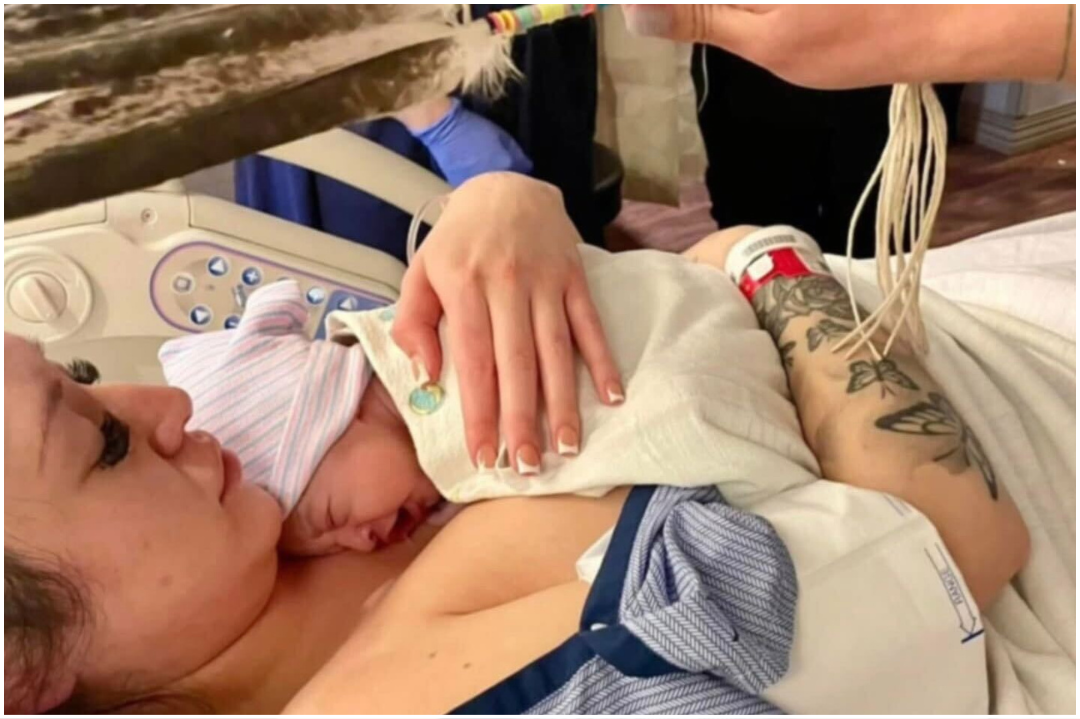
Photo of a Native family receiving support during birth from Indigenous Doula, Julianne Denny (Cree/Ojibway/Miqmaq).
On National Rural Health Day, I want to talk about what “access to care” means for Native Birthing Families in Montana. When we talk about access to maternal health care, we’re not just talking about whether a clinic or hospital exists. For our families, access means how far away your prenatal appointment is. Whether you have your own transportation or not, or if someone can travel with you. Whether or not you can afford to take that much time off of work, who will watch your other children, and whether the road conditions are safe. And once you make it to your appointment, whether you will be respected and cared for when you walk through those doors.

In Montana, 57.1% of counties have no hospital or birth center offering maternity care. A 2023 study examining obstetric access in Montana found that among patients with pregnancy-related health risks who traveled beyond their nearest obstetric hospital to give birth, American Indian and Alaska Native (AIAN) patients traveled nearly 24 miles farther than White patients with similar risks. Another Montana study using 2014–2018 birth certificate data found that AIAN patients travel 24.2 minutes farther on average than White patients to give birth and were 20 times more likely to give birth at a hospital without obstetric services.
57.1%
of Montana counties have no hospital or birth center offering maternity care
~24 miles
farther traveled by AIAN patients than White patients with similar pregnancy risks
20×
more likely for AIAN patients to give birth at a hospital without obstetric services
For perspective, our pregnant relatives living on the south end of Fort Belknap need to travel over 80 miles one-way for prenatal care, delivery, or postpartum care. That’s 160 miles round trip, 1 hour 20 minutes there, the time for the appointment, maybe lab tests if they’re ordered, should probably stop for fuel and something to eat, then drive back another 1 hour 20 minutes. That’s at least half a day in a state where we don’t have maternity leave, we don’t have universal childcare, and we have some of the most dangerous highways in the country.
160 miles round trip. At least half a day.
No maternity leave. No universal childcare. Some of the most dangerous highways in the country.
And then our healthcare systems can turn around and describe someone as “noncompliant” when they miss an appointment. But we know to ask a different question. Instead of asking what is wrong with the patient, what happens when we ask:
What barriers did the system place around that family?
For many Native Birthing Families in Montana, access to maternal healthcare isn’t just about whether the care exists or not. It’s about how far away the right kind of care is from home, whether someone can physically get there, whether they can afford to make the trip, whether the services they need are available when they arrive, and whether they feel respected and safe once they walk through the door.
Distance is not an accident
We also need to remember that the rurality of many Tribal Communities is not an accident; it’s actually by design. When we talk about Reservations as rural or isolated, we need to understand that we are talking about places that were created and shaped by Federal Indian Policies, treaty-making, land dispossession, and forced relocations.
Sometimes when we talk about rural health, especially in Montana, we treat distance as if it’s just an unfortunate fact of life. But for Native families, our geography cannot be separated from that history. Families weren’t living near healthcare systems that later disappeared. Federal policies not only dictated where Reservations would be located, they also determined generations of infrastructure and healthcare investment decisions that shaped what services would be available.
An important piece of this is recognizing that federal policies and healthcare systems increasingly moved Native reproductive care away from homes and community-based ways of caring for families and into institutional medical settings. When birth was taken away from our communities, we didn’t just lose proximity to care. We were also deprived of opportunities for cultural knowledge, family relationships, ceremony, language, and community support to naturally surround pregnancy and birth to be passed on to the next generations.
So on top of the great distances Native Birthing Families are traveling to hospitals and birth centers, we need to also consider that these are spaces where their culture and community are likely not reflected in the care they receive.
Why Indigenous birthworkers matter
This is one reason why Indigenous Birthworkers are essential to the rural health conversations. A doula does not replace an OB, midwife, nurse, or a hospital, but they can help support families as they navigate a healthcare system that may take them away from home. And they can provide something our healthcare systems currently can’t provide: cultural continuity. In addition to providing continuous physical, emotional, and informational support, they can help families stay connected to their own values, relationships, cultural practices, and community during an experience that has become increasingly separated from home.
Indigenous doulas don’t replace the healthcare infrastructure our communities deserve. They help restore something that healthcare infrastructure alone cannot provide: relationship, continuity, and connection to community.
This support is especially important during the postpartum period because this is where we lose people. Currently most postpartum care involves one six-week appointment and unless referrals are made in that appointment, that can be the end of the postpartum care they receive. Montana’s most recent Maternal Mortality Review Committee report states that American Indian and Alaska Native people accounted for 27.3% of the 11 pregnancy-associated deaths it reviewed from 2020. Eight of those 11 deaths occurred between 43 days and one year postpartum.
27.3%
of the pregnancy-associated deaths reviewed from 2020 were American Indian and Alaska Native people
8 of 11
deaths occurred between 43 days and one year postpartum
In rural health conversations, we spend a lot of time asking how we bring healthcare professionals closer to communities. We need to also ask how we resource and strengthen the systems and people who are already there.
SB 319 created an opportunity
This is why Montana’s investment in the doula workforce is so much more important than just creating another healthcare profession. During the 2025 legislative session, lawmakers from both sides of the aisle passed Senate Bill 319, creating a licensing framework for doulas and authorizing DPHHS to provide Medicaid coverage for doula services. One thing I am especially proud of is that Indigenous doulas were involved in Montana’s process. That matters because policies designed to improve access can still create new barriers if the people most affected aren’t helping shape them.
While we can only do so much within these systems that were not designed for us as Native people, it’s still important to participate because the policies created within those systems affect our communities and families. The doula bill wasn’t perfect, but policy doesn’t have to be perfect for us to recognize an opportunity to improve access. Not every doula in Montana wants to pursue licensure, we know that. For Indigenous doulas, participating in this process was about creating another pathway for Native families to access support while also creating a pathway for birthworkers to be compensated for work they are too often providing for free. This gives us an opportunity to begin sustainably resourcing people who are already helping families bridge the distance between community, culture, and healthcare systems.
But implementation matters. This week we received word that Montana Medicaid received approval to begin reimbursing for doula services and implementation is moving forward. If this policy is going to improve rural maternal health, Indigenous doulas need to remain at the table as the system is built. We need to make sure licensing and reimbursement don’t unintentionally create new barriers for community-based birthworkers, and that Indigenous knowledge isn’t lost as doula care becomes more integrated into formal healthcare systems. SB 319 created an opportunity. Our next responsibility is making sure implementation actually results in more Native and rural families being able to access doula support, and that Indigenous birthworkers can build sustainable livelihoods doing this work.
An even larger opportunity
Montana now has an even larger opportunity. Montana received $233.5 million for Year 1 of the federal Rural Health Transformation Program. Earlier this month, Montana announced another $239.7 million Year 2 award. This program is specifically intended to strengthen rural healthcare workforce, access, community health infrastructure, and new models of care. Maternal health, and the Indigenous birthworkers already helping families navigate these systems, belong in that investment. If Montana wants to transform rural health, Native maternal health needs to be part of that transformation. This could look like:
Strengthen the rural maternal-health workforce.
That should include doulas and community-based birthworkers alongside clinical workforce investment.
Support Indigenous doula workforce development.
Training, mentoring, professional development, Medicaid enrollment assistance, connections with healthcare systems, and sustainable compensation.
Make telehealth actually useful for pregnancy and postpartum care.
Not as a substitute for local services, but as a way to connect rural families with maternal-fetal medicine, perinatal mental health, lactation, and other specialty care when clinicians are hours away.
Invest in community-based maternal health infrastructure.
Tribal health programs and Native-led organizations should be eligible and competitive participants, not afterthoughts.
Measure whether investments reduce travel burdens.
If “transforming rural health” never changes how far a pregnant person must travel for appropriate care, that’s worth questioning.
Include Tribal communities upstream.
Not after an RFP has already been written.
The governor’s announcement about this award said that Montanans should be able to get quality healthcare “without leaving the communities they call home.”
I couldn’t agree more. And if that’s our goal, we need to include pregnant and postpartum Native families in what we mean by rural healthcare transformation.
A Native mother shouldn’t have to travel farther simply because of where federal policy placed her community generations ago. And when families do have to travel for specialized care, they deserve systems of support that travel with them and welcome them home.
What we’re building at Berry Medicine
At Berry Medicine, we’re already working on pieces of this future. Through our Indigenous BirthWorker Network, we’re helping birthworkers connect across geographically isolated communities, share resources, strengthen their skills, and build relationships. We’re training healthcare systems and providers on cultural safety, advocating for policies that improve access, and building the Family Birth Fund so families don’t have to wait for every policy and reimbursement system to catch up before they can receive support.
We don’t see Indigenous doulas as a substitute for the healthcare infrastructure Native communities deserve. We see them as an important part of a stronger maternal-health system: people who can walk alongside families, help connect community, culture and clinical care, and bring relationships, culture, and continuity into a system where those things are too often lost.
Montana has hundreds of millions of dollars on the table to rethink rural healthcare. Let’s make sure Native mothers, birth givers, babies, and families aren’t an afterthought in that transformation.
We know our communities hold solutions to these issues.
We know who is already doing the work.
And we’re ready to help build what comes next.
Follow Along
I’ll continue sharing the stories I want Montana to pay attention to: what we’re learning at Berry Medicine, the solutions already taking shape in our communities, and what becomes possible when we make intentional investments to support this work.
I hope you’ll follow along.
Sign Up Here For News & Updates

Dr. Amy Stiffarm
Dr. Amy Stiffarm (Aaniiih, Chippewa Cree, and Blackfeet) is the Founding Executive Director of Berry Medicine Native BirthWork Initiatives. She has worked in Indigenous maternal health for more than 12 years and holds a PhD in Indigenous Health from the University of North Dakota, where her dissertation focused on mental health for Indigenous birth givers.