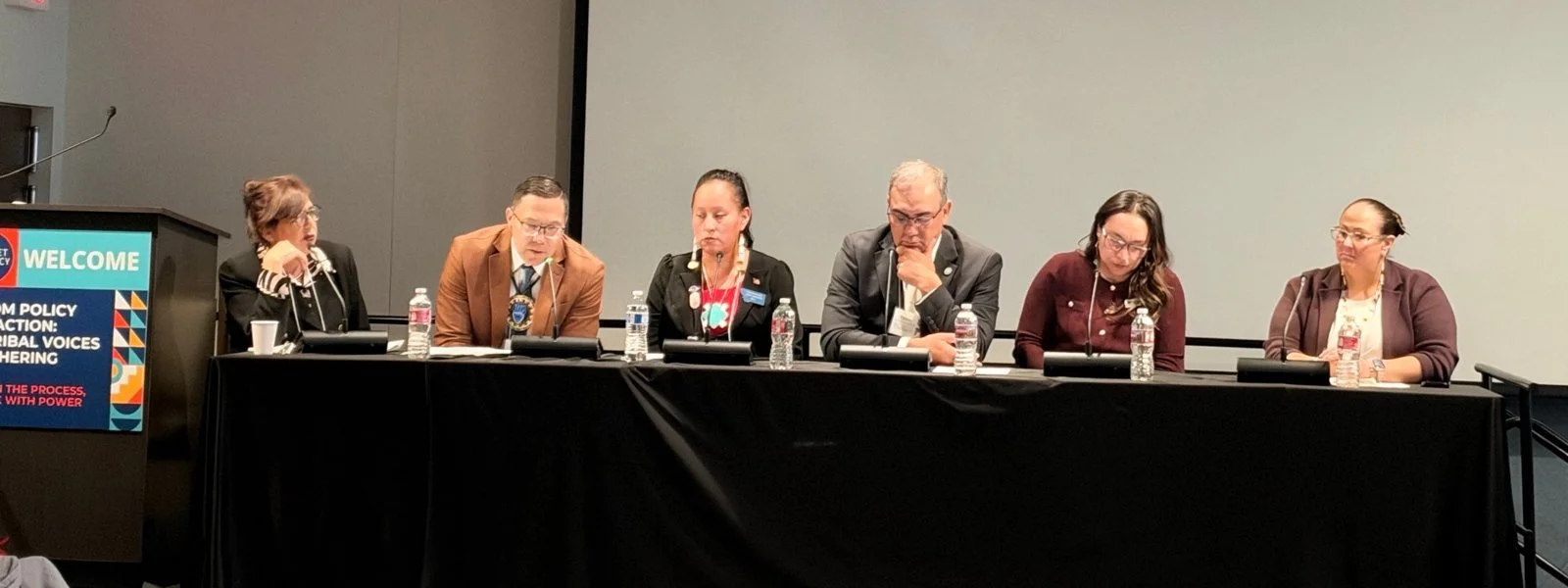
Future State Investments for Indian Country Panel at: From Policy to Action: A Tribal Voices Gathering in Helena, MT
Earlier this week, I had the privilege of attending From Policy to Action: A Tribal Voices Gathering, hosted by the Montana Budget & Policy Center in Helena. The gathering brought together leaders from Tribal Nations, Tribal colleges, state policymakers, and community advocates to discuss the work ahead of Montana’s 2027 legislative session. I was able to speak on a panel with some amazing leaders in Indian Country and share some insights about future investments our state could make related to maternal health that would support the health and well-being of our communities.
While I left the event feeling hopeful, I was reminded of how much of that work goes unrecognized, and how often Native people are left out of the broader public conversation altogether.

After a full day of panels and seeing so many familiar faces, I left feeling hopeful. There is so much knowledge, leadership, and meaningful work already happening across our Tribal communities. And there are people who recognize the importance of bringing Native voices into conversations about policy and decisions that affect our lives. But it also reminded me how much of that work goes unrecognized, and how often Native people are left out of the broader public conversation altogether.
During this election cycle, Berry Medicine joined several community partners to host Maternal Health in Montana: U.S. Senate Candidate Forum in Billings. The forum was an opportunity to hear directly from candidates about issues affecting Native mothers, babies, and families, including access to care, Tribal sovereignty, and the federal government’s responsibility to Tribal Nations.
When candidates were asked about the federal government’s role in supporting Tribal Nations to lead their own maternal and infant health programs, one candidate responded with a dehumanizing comparison about Native people. And suddenly, that became the story.
Not the maternal health challenges our families face. Not the Indigenous-led solutions already happening across Montana. Not even the actual question about how the federal government can better support Tribal maternal and infant health.
Instead, another opportunity to discuss an issue that deserves serious attention became a conversation about disrespectful remarks and political controversy. Honestly, I wasn’t interested in giving another clickbait headline my attention, so I didn’t even open the articles I saw about it. Closing in on the end of an exhausting election cycle, I didn’t want to contribute to another story that framed Native people through deficit, dependency, and controversy.
What bothered me more was watching Native people once again carry the burden of explaining who we are, defending our sovereignty, and educating others about our history. And this isn’t limited to public controversy. Too often, the people making decisions that affect our lives have little understanding of Tribal sovereignty, treaties, or the Tribal Nations that STILL EXIST in Montana. Native people are continually expected to explain these things, even to professionals whose responsibilities should require them to understand. That’s a lot of time and energy spent educating others when we could be putting that energy toward advancing solutions in our own communities.
So when I was asked to participate in an interview, I agreed because I saw an opportunity to redirect the conversation toward the reason we gathered in the first place: Native maternal health. Although the initial story largely missed that opportunity, I shared my concerns with the newsroom team, and to their credit, they listened, revisited the story, and added important context. I appreciate their willingness to do that. But think about that for a moment.
The comment was made at a maternal health forum, and it took additional advocacy to get maternal health into the story.
We were so close to having a meaningful public conversation about an issue that deserves attention and demands solutions. Instead, the conversation became another opportunity for controversy and division. And unfortunately, this isn’t unique to news coverage.
What happens when we aren’t seen?
Native maternal health doesn’t just get overlooked in the headlines. Too often, we’re barely visible in the data that should be informing those headlines in the first place.
Being counted matters. For too long, Native people have been misclassified, grouped into categories like “Other” or “multiracial,” left out of reports, or had our data suppressed because our population was considered too small to report separately. These aren’t harmless technical decisions. They shape whether our health inequities are seen and whether our communities receive attention, research, policy action, and resources.
Consider the CDC’s maternal mortality reports covering 2020–2022. These reports received national attention, but American Indian and Alaska Native women weren’t included in racial comparisons because our data got moved to the “Other” category. Later analyses brought our outcomes into focus, revealing some of the highest maternal mortality rates and showing how racial misclassification had caused Native deaths to be overlooked.
But by then, the headlines had been written, the conversations about priorities and funding were already happening, and the attention had shifted. Our story felt like it was an afterthought.
Abigail Echo-Hawk from the Urban Indian Health Institute describes this as “data genocide,” the erasure of Native people through the systems meant to count and understand us. When Native mothers and birth givers disappear from the data, it becomes easier for their experiences to disappear from headlines, funding decisions, and policy conversations too.
Data inform reports. Reports generate attention. Attention influences funding, policy, and priorities. Ultimately, those decisions determine who has resources, representation, and power. When Native people are missing from the data, we’re more easily left out of the conversations and decisions that follow. If we aren’t accurately counted, how can we expect our communities’ needs to be understood, prioritized, or addressed?
We deserve to be counted accurately and represented fully.
Because when Native families are visible in the data, their experiences become harder to overlook in the media, in policy, in funding decisions, and in the systems built to serve them.
At Berry Medicine, part of our work is making sure Native families are not only visible in these conversations, but helping shape what happens next. But here’s what I want people to understand: Our communities aren’t waiting around for someone else to figure out what to do.
Across Montana, Indigenous birthworkers, Tribal programs, community leaders, Elders, and Native-led organizations are already doing incredible work to support families, strengthen cultural knowledge, improve access to care, and create solutions grounded in our communities. That work deserves to be seen, supported, and invested in.

An invitation to Montana’s leaders
As Montana’s newly elected leaders prepare to govern, and as returning lawmakers, state agencies, healthcare systems, funders, and others continue making decisions that affect Native Birthing Families, I want to extend an invitation: come work with us.
You don’t have to show up knowing everything. But you do have a responsibility to learn. Learn about the Tribal Nations in our state. Learn about sovereignty, treaties, federal Indian policy, and the trust responsibility, not as abstract pieces of history, but as part of understanding the Montana you serve.
Take responsibility for your own learning rather than continually placing that burden on Native communities. Listen directly to Native mothers, birth givers, families, Elders, birthworkers, Tribal leaders, and communities. Don’t wait for another controversy before seeking Native expertise.
Partner with Tribal Nations and Indigenous-led organizations before policies are written, programs are designed, or funding decisions are made. And recognize and invest in the Indigenous-led work already happening across Montana: our birthworkers, culturally safe healthcare, community-based programs, community-driven research and data, cultural revitalization, and Native-led organizations.
This is the systems-change work Berry Medicine exists to help move forward. We are working to make Native families, knowledge, birthworkers, data, and community-led solutions more visible in the systems where decisions are made. We’re building relationships across communities, strengthening the Indigenous birth workforce, bringing Native voices into maternal-health planning and research, supporting culturally grounded approaches to care, and helping healthcare professionals and institutions understand how they can create safer systems for Native families.
We don’t believe Native communities need someone else to come up with the answers for us. We believe our communities already carry knowledge, leadership, and solutions, and our work is about helping create the conditions for those strengths to be recognized, resourced, and sustained.
That’s why investment matters. When you invest in Berry Medicine and other Indigenous-led organizations, you’re not investing in another outside solution being brought into Native communities. You’re investing in the people, relationships, knowledge, data, birthworkers, and solutions that are already here.
We are here. We have been doing this work.
And we are ready to work together.

This week’s Tribal Voices Gathering reminded me that there are people across Montana who are willing to listen, learn, and work together to address the issues our families are facing. The knowledge, leadership, and solutions already exist in our communities. What we need is for that work to be recognized, included in the decisions shaping our future, and supported with the resources necessary to grow.
This isn’t an invitation to come save us.
It’s an invitation to work alongside us.
And that invitation isn’t only for policymakers. All of us have a role in deciding what work receives attention and what work is sustained. Berry Medicine exists to help change the systems surrounding Native Birthing Families. We know we can’t do this work alone, and we’ll take all the help we can get.
Follow Along
Over the next few weeks, I’ll share more of the stories I want Montana to pay attention to: what access to care really means for Native Birthing Families, the progress we’re making together, the history that shapes our systems, and what becomes possible when we invest in what is already growing.
I hope you’ll follow along, learn alongside us, and find your place in this work.
Sign Up Here For News & Updates

Dr. Amy Stiffarm
Dr. Amy Stiffarm (Aaniiih, Chippewa Cree, and Blackfeet) is the Founding Executive Director of Berry Medicine Native BirthWork Initiatives. She has worked in Indigenous maternal health for more than 12 years and holds a PhD in Indigenous Health from the University of North Dakota, where her dissertation focused on mental health for Indigenous birth givers.